AN ASYLUM seeker who dodged deportation has been arrested over a rape and an attempted murder, police said yesterday.
Dangerous fugitive Caliph Ali Asmar, 25, was nabbed after a call from a member of the public following a nationwide alert.
Asmar, an Iraqi Kurd, was being hunted after a man was stabbed and seriously injured in Hull on Good Friday. He was also wanted for questioning over a serious sexual assault on a girl of 15 who was dragged into a car in the same city.
This week it emerged that Asmar first applied for asylum in Britain in 2001 and was refused, but he was not removed.
In 2005 he was jailed for two years at Hull Crown Court for wounding and the judge, Recorder Andrew Woolman, recommended him for deportation.
He was freed after only eight months — but officials under crisis-hit Home Secretary Charles Clarke ignored the judge’s advice and allowed him to stay in the country.
Asmar was arrested with four other men at an address in central Hull at around 10.30pm on Wednesday night.
Humberside Police said the other men, aged between 19 and 32, were being held in custody on suspicion of assisting an offender.
The Home Office would not comment on whether Asmar was on the list of foreign criminals who should have been deported after their release from prison.
Hull North MP Diana Johnson has promised to investigate the case.
Friday, May 05, 2006


Thursday, May 04, 2006
BBC Weeps for Moussaoui
The BBC paints 9/11 conspirator Zacarias Moussaoui as the victim of a bad childhood who just wanted to be a good Muslim: Restless convert in quest for jihad.
Abdul Haq Baker was the mosque’s chairman and became Moussaoui’s friend and confidant.
Mr Baker remembers Moussaoui as an affable individual with a sense of humour which attracted him to others, but also an admirable seriousness about his faith.
"He wanted to revive his roots which were in Islam. He wanted to be a good Muslim, a knowledgeable Muslim, who wanted to know how to implement the tenets of Islam and make sense of the society he was living in," said Mr Baker.
At the mosque Moussaoui would normally be accompanied by his childhood friend Xavier Jaffo. Both men would take the road to radicalism that would lead them to aspire to martyrdom.
Notice how the BBC’s Acme scare quote generator seems to be on the fritz again. "Aspire to martyrdom?"
Terror suspect led prison prayers
A man accused of conspiring with Osama Bin Laden in the bombings of two US embassies was allowed to lead Islamic prayers in prison, the BBC has learned.
The Prison Service said Khalid al Fawwaz led prayers in Woodhill Prison, Bucks, for a "short period" in 2003.
It had been allowed so Muslim prisoners were not denied the chance to worship, the service said.
The US wants to extradite Mr al Fawwaz in connection with the 1998 bombings of the US embassies in Kenya and Tanzania.
He has been held at Woodhill since his arrest in 1998. More than 200 people were killed in the attacks.
BBC Radio 4's The Battle for Influence spoke to a former inmate, who for four months in 2003 attended prayers led by Mr al Fawwaz.
There is a risk when we have got lots of relatively young men gathered together that they move into radicalising each other Phil Wheatley Prison Service director general
Raja Mouib said: "When he used to do the prayers he used to get hold of you... the kind of things he would say, the way he prayed, it was like he put everything into it.
"He had that strong kind of effect that got hold of you."
The Prison Service said: "For a short period in 2003, a decision was taken at HMP Woodhill that it was appropriate for Muslim prayers to be led by a prisoner rather than deny Muslim prisoners the ability to practice communal worship, while a longer term solution was put in place.
"We are now able to ensure prayers are led by a prison-appointed imam."
Prison Service Director General Phil Wheatley also told the programme that a scheme had been in place for a year aimed at preventing Muslims in London jails becoming radicalised.
Project Muslim provided inmates with a Muslim mentor so that "people who potentially can be radicalised have the support - emotional and intellectual and spiritual - from someone within their community which makes it less likely they will be radicalised".
Mr Wheatley said: "I think there is a risk when we have got lots of relatively young men gathered together - who may well be coming back to their religion or coming afresh to the religion - talking amongst themselves, that they move into radicalising each other.
"I think we ought to be alert to that risk. It's reduced if we can connect them to proper religious leadership rather than a group of people who have already drifted off into crime."
The Battle for Influence obtained figures showing that Muslims make up more than 10% of the prison population - 8,044 of 76,717 inmates. Muslims in England and Wales make up about 3% of the population overall.
more prison storys,
Tuesday, May 02, 2006
Life for 'merciless' murder gang
Four men who murdered a stranger they bumped into on a night out in London's West End have been jailed for life.
Assistant bank manager Bobby Ilham, 24, son of a top Pakistani cricketer, was chased by the gang who knocked him to the ground and stamped on his head.
The Old Bailey heard the fatal attack, in May 2005, was a "merciless and motiveless" public killing.
Rashid Tabali, Hassan Al-Soltan, Ahmad Alkhateeb and Mishal Al-Fahad, all from London, will serve at least 15 years.
Mr Ilham, son of former Pakistan international cricketer Ilham Mohiuddin, had been out with friends and they were making their way back to a car when they bumped into the four-strong group near Leicester Square.
A fight started and Mr Ilham became separated from his friends.
The four men then chased him into Whitcomb Street before knocking him to the ground.
As he lay there, his head was stamped on and kicked and he was beaten with belts.
Prosecutor Jeremy Donne told the trial: "He suffered a very public and brutal death. He was brought to the ground where he was subjected to a vicious and sustained beating."
Mr Ilham worked at a bank in Sutton, south-west London and lived with his parents in nearby New Malden, where he had just bought a flat.
His father, Ilham Mohiuddin, a former Pakistan international and Essex county cricketer, read a statement about the impact the murder had had on the family.
"Those who committed this brutal and senseless act of irreversible violence were stamping on our son's head, in a moment of drunken madness, with no regard or comprehension for the devastation being unleashed with every blow," he said.
"With every stamp on our son's head they stole his life and murdered the lives of those he has left behind."
Sentencing the four to life terms - they must serve at least 15 years each - Judge David Paget said: "This was an act of appalling, relentless, unnecessary violence."
He added that while Mr Ilham had "a bright future in front of him and had achieved so much", his attackers had never achieved anything.
Drug dealer jailed for gruesome "canal" murder
A Moroccan drug dealer was jailed for life on Thursday for killing his boss, chopping the body into 133 pieces and throwing them into a canal before setting his flat on fire in a bid to destroy evidence.
Abdul El-Gharras, 31, was obsessed with decapitation and had downloaded videos of al Qaeda beheadings before murdering Marvin Gentles last June in an argument over crack cocaine, the Old Bailey criminal court heard.
He stabbed his victim 26 times, cut up the corpse, stuffed the pieces into plastic bags and wheeled them to the canal in a shopping trolley. The murder came to light when a passer-by spotted one of the bags and pulled it out of the water.
After disposing of the body, El-Gharras returned to his flat and tried to clear up the mess. When he failed, he doused it in petrol and set fire to it.
El-Gharras pleaded guilty to murder and will serve at least 18 years and eight months before being considered for release.
biased bbc
The BBC fails to always give a "full and fair account" of the Israeli Palestinian conflict but is not deliberately biased, a report has said.
The BBC governors asked an independent panel to scrutinise its output.
Its report said the BBC was committed to being fair, accurate and impartial and UK viewers regarded it as unbiased.
But coverage was not consistently full and fair and "in important respects, presents an incomplete and in that sense misleading picture", it found.
The panel, chaired by British Board of Film Classification president Sir Quentin Thomas, examined only the corporation's UK domestic public service output.
Sir Quentin said: "What the BBC does now is good for the most part - some of it very good.
"But it could and should do better to meet the gold standard which it sets itself in its best programmes."
The report said: "Apart from individual lapses, sometimes of tone, language or attitude, there was little to suggest systematic or deliberate bias.
"On the contrary, there was evidence, in the programming and in other ways, of a commitment to be fair, accurate and impartial."
The report also said: "There is high quality reporting from location, some outstanding current affairs programmes and the website provides much valuable historical and other context."
But there were gaps in analysis, context and perspective as well as a failure to consistently uphold editorial standards, it continued.
Broadcast news lacked historical background, stories were often not put in the wider context and there was insufficient analysis and interpretation of important events and issues, the report said.
The range of stories and perspectives was too narrow and reporters' use of language was often inconsistent, it decided.
That included the use of the words "terrorism" and "terrorist". The BBC advises its journalists to avoid the latter because it can be "a barrier to understanding".
But the panel said the BBC should use "terrorism" to describe violence against civilians with the intention of causing terror for ideological objectives, "whether perpetrated by state or non-state agencies".
"It seems clear that placing a bomb on a bus used by civilians intending death or injury in supposed furtherance of a cause is a terrorist act and no other expression conveys so tersely and accurately the elements involved."
BBC chairman Michael Grade responded to the report by saying the finding of no deliberate or systematic bias was "reassuring".
"The panel found much to praise, but it also identified some shortcomings in the BBC's coverage," he said.
"We have asked BBC management to consider the panel's recommendations and respond to us at our June board meeting."
He added the corporation must continually demonstrate its efforts to meet the highest editorial standards because impartiality was the most important safeguard of the BBC's editorial independence.
A statement from BBC News management pointed to "recent developments to strengthen performance" such as the appointment of Jeremy Bowen as Middle East editor and a major training programme.
"We are pleased the panel commends the quality and authority of our reporting from the Jerusalem bureau," it said.
"We agree there is more we can do to provide greater context and understanding for audiences on the conflict.
"We are confident we have the right editorial structures and processes in place to provide high quality, impartial journalism and to ensure we continue to make progress in developing the authority and comprehensiveness of our output."
"Their contribution will assist the BBC in providing the best possible news coverage for licence fee payers."
BBC executives will now prepare a plan for the governors detailing how they intend to implement "appropriate recommendations".
Monday, May 01, 2006
Honor Killing Victim Discovered in Britain
The uncle of a woman whose body was found in a suitcase appeared in court charged with her murder.
Ari Babakir Aga, 50, was remanded in custody at Woolwich Magistrates' Court, south east London, Scotland Yard said.
He is charged with murdering his niece Banaz Mahmod Babakir Agha, who went missing from her home in Mitcham, south London, three months ago.
The date for the next appearance by Aga, a businessman from Mitcham, was not immediately known.
Remains of a body - believed to be the 20-year-old - have been discovered during a search of a property in Birmingham.
A 29-year-old man has already been charged with murder, and 16 other people have been arrested and released on police bail while inquiries continue.
Four suspects who were re-arrested for further questioning have been released on police bail.
Banaz, who was of Kurdish origin, vanished on January 23. She withdrew no money from her bank account following her disappearance, nor did she take a change of clothing or passport with her. The missing persons inquiry rapidly became a murder investigation. Police said they believed Banaz's disappearance may be linked to a failed arranged marriage. One line of inquiry was that she may have been murdered in an "honour killing". A force spokeswoman said: "The body is believed to be that of Banaz Mahmod Babakir Agha, 20, who was last seen at 5.50pm on Monday January 23 in Cricket Green, Mitcham." A 29-year-old man was charged previously in connection with the investigation and a further eight people arrested and bailed pending further inquiries. The spokeswoman said two of those people had been rearrested and taken into custody at police stations in London.
Banaz, who was of Kurdish origin, vanished on January 23. She withdrew no money from her bank account following her disappearance, nor did she take a change of clothing or passport with her. The missing persons inquiry rapidly became a murder investigation. Police said they believed Banaz's disappearance may be linked to a failed arranged marriage. One line of inquiry was that she may have been murdered in an "honour killing". A force spokeswoman said: "The body is believed to be that of Banaz Mahmod Babakir Agha, 20, who was last seen at 5.50pm on Monday January 23 in Cricket Green, Mitcham." A 29-year-old man was charged previously in connection with the investigation and a further eight people arrested and bailed pending further inquiries. The spokeswoman said two of those people had been rearrested and taken into custody at police stations in London.
Sunday, April 30, 2006
Seeking out the suicide bombers

Anti-terrorist experts are floundering about trying to understand Islamic suicide bombers in the UK and the rest of Europe.
The experts came together and argued together at a conference in London organised by the Centre for Defence Studies at King's College and the Norwegian Defence Research Establishment.
The conference sought to assemble "the puzzle that will help us better understand what determines and motivates the actions of individual jihadists."
The puzzle however remained frustratingly in pieces.
One major argument was about the issue of psychological profiling. This seeks to understand the motives of one group of terrorists in order to predict who might be the next.
I believe the psychological profiling of Islamic terrorists is a complete waste of time Dr John Horgan University of St Andrews
To a layman it sounds quite reasonable - and indeed there was a fascinating analysis of the 7/7 London bombers - but it came under sustained attack from one of the speakers, Dr John Horgan, a psychologist at the University of St Andrews, which has specialised in anti-terrorist studies.
"I believe the psychological profiling of Islamic terrorists is a complete waste of time," he said.
"It will not work. It means different things to different people and there is the wrong assumption that if we can identify the traits of known terrorists we can move into predictions.
"The terrorists are not a homogenous population and we simply do not understand why some move from legal activities to illegal."
"Too much is based on a limited range of people and we are seeing only the tip of the iceberg."
I asked Dr Horgan afterwards what should be done instead.
Social profiling
"Psychological profiling is beguiling," he said. "Social profiling, looking at the social background, is more useful.
"It's also important to look at the ways in which a person gets drawn into terrorism and from that to develop counter -terrorism strategies. There is an "IED" progression, from involvement to engagement and then, in some, to disengagement from terrorism.
"At points along this line, we can try to stop them. For example in Northern Ireland, the racketeering that went on in paramilitary groups was exposed. That undermined the idealism of some who thought they might join."
'Al Capone approach'
Others at the conference suggested the "Al Capone" approach, in which the financial dealings of activists could be targeted.
Despite Dr Horgan's comments, there was a good deal of profiling on display at this conference.
Peter Nessen of the Norwegian Defence Research Establishment had analysed the London suicide bombers and came up with a typology, which, he said, provided important lessons.
He identified four types of terrorist in the four young men who blew themselves and others up:
the entrepreneur
the protégé
the misfit
the drifter.
'Sense of injustice'
The entrepreneur, or leader, was Mohammed Siddique Khan. This figure, said Peter Nessen, is the crucial one, who makes things happen. He is often an idealist as Khan was. Khan had an "activist mindset." He had been active in protests on behalf of the Kashmiri community before. He had a strong sense of injustice on behalf of Muslims around the world.
"But this figure often needs contacts with a radical imam for religious guidance and, for practical purposes, contacts with the jihadi infrastructure, though instructions can also be got from the internet," said Nessen.
The second figure, the protégé, he identified in this group as Shezad Tanweer.
"The protégé might be younger and certainly looks up to the leader. He is also activist minded, also educated and is sometimes skilled. He might be used for bomb making. Tanweer went to Pakistan with Khan in 1994, so was close to him."
The third type, the misfit, was Hasib Hussain.
The misfit, according to this theory, is someone with a troubled background, not an idealist. He joins because of personal problems, which he thinks will thereby be solved. He might even join out of loyalty to his friends. He is streetwise but not well educated and might have violent tendencies.
The fourth type, the drifter, was said to be Jermain Lindsay.
"This kind of person drifts into the group through circumstances or contacts. He might not have been an activist before and might not be entrusted with key details of the group's activities," said Nessen.
The lessons, Nessen said, were that there were different ways into terrorism, that the role of the "entrepreneur" was crucial, but that this was not enough. There had to be connections outside the group, to religious leaders and jihadi structures.
Converts
We were also given a glimpse into the phenomenon of converts, some of whom, like the shoe-bomber Richard Reid, then went onto to violence.
Alison Pargeter, of King's College pointed to similarities between 34 converts she had identified. They were often fragile individuals from deprived and broken homes, looking for a way out. They were also vulnerable to influence as they were not able to distinguish between moderate and more extreme branches of Islam and were drawn into "purer" forms from which the leap to violence was easier.
As for social profiling, there was an interesting account of the background in Spain, which suffered in the Madrid bombs in 2004.
Professor Fernando Reinares of the Elcano Royal Institute in Madrid, said that, unlike the situation in the UK, there was no mature second or third generation of immigrants in Spain yet, so most of the 188 jihadists arrested since 2001 had been from abroad, mostly Morocco and Algeria. The Spanish authorities were now looking closely at the influences on the upcoming generations.
Professor Reinares also pointed out the problems of prediction and said the Madrid bombers were very varied, with both university graduates and illiterates in their ranks.
I felt that the conference rather ignored some of the political influences on suicide bombers, like the world events -Afghanistan, Iraq, the Middle East, Chechnya, Bosnia and others - that provide a basic motivation for many of them.
In one off-the-record session there was a reference to this from a contributor who did call for a better Western approach on a global scale, arguing for patience and a clear human rights framework for policies.
Perhaps this was felt to be too intangible for such a meeting. Certainly some of the policemen there were more interested in what they could do in practice.
'No silver bullet'
One of them, Chief Inspector Mick Gillick of West Midlands police, who works with Muslim and other communities in his patch, said there was "no silver bullet."
"I am a little bit sceptical about profiling being the answer to predicting terrorism," he told me, "though I recognise the concept of the entrepreneur. However, because Khan became a terrorist after being an activist, it does not follow that other activists will become terrorists.
There will be more bombers Michael Taarnby Danish Institute for International Studies
"I know that intelligence agencies these days are looking "upstream" to see who might be shaping up as suspects, but my role is to develop relations with the communities and this is vital because they will be the ones who tell us if something is suspicious."
One speaker who had made a grimly successful prediction was a ZDF German television journalist Elmar Thevessen. He made a documentary in 2004 about a possible attack on the London Underground.
The German authorities were on high alert because of the World Cup this summer, he said, worried because a jihadist pamphlet called "The Unfulfilled Duty" had recently appeared.
It was, unusually, written in German, not Arabic or English, a sign that those behind the pamphlet were now appealing to young people who were deeply embedded in German society.
Michael Taarnby of the Danish Institute for International Studies, who has analysed jihadists across Europe, predicted what everyone fears.
"There will be more bombers," he said.
Friday, April 28, 2006
Al-Qaeda pen bombs plot
 ABU Hamza fanatics are urging fresh suicide attacks on passenger jets, using mini-bombs in pens and disposable cameras.
The call is aired on an website run by supporters of the jailed hook-handed cleric.
It recommends the use of a high-powered explosive dubbed Mother of Satan, which is of the same type used by the July 7 bombers.
The threat was discovered by internet terror expert Neil Doyle.
He said yesterday: "The plans describe how to build the successor to the shoe bomb.
"Only a small explosion is needed to puncture the fuselage of an airliner, leading to depressurisation and destruction."
Step-by-step instructions are available in Arabic on a website operated by the shadowy Islamic Media Centre, which has repeatedly voiced support for Hamza.
They suggest targeting planes taking off from Third World airports where security is more haphazard — and detonating bombs inside aircraft toilets.
Mr Doyle added: "This proves al-Qaeda’s bomb makers are trying to come up with new methods of attack."
Hamza, whose hook appears as a logo on the site, is serving seven years for inciting murder and stirring race hate in sermons.
Thursday, April 27, 2006
Iran has missiles that put Europe in range: report
Iran has received a first shipment of missiles from North Korea that are capable of reaching Europe, Israel's military intelligence chief was quoted on Thursday as saying.
Known in the West as BM-25s, the Russian-designed missiles have a range of around 1,500 miles, giving them a longer reach than the Iranian-made Shihab-4 missiles which are capable of hitting Israel.
The intelligence chief, Major-General Amos Yadlin, was quoted by Israel's Haaretz newspaper as saying in a lecture on Wednesday that some BM-25s had arrived in Iran.
told Reuters,
rants and raves from iran
Wednesday, April 26, 2006
Ballot controversy hits town hall
THE Town Hall elections exploded into controversy this week as an extreme Muslim sect hijacked a public debate and the council and Special Branch launched a major probe into allegations of postal fraud.About a dozen police swooped on the Brady Centre in Whitechapel on Tuesday night after it was taken over by the radical Islamist group al-Ghurabaa, which wants to rid Britain of democracy and which last year tried to briefly abduct MP George Galloway.As officers dealt with the melee, one sect member, who had been shouting that only Allah had the right to make laws, threatened to beat up a press photographer.
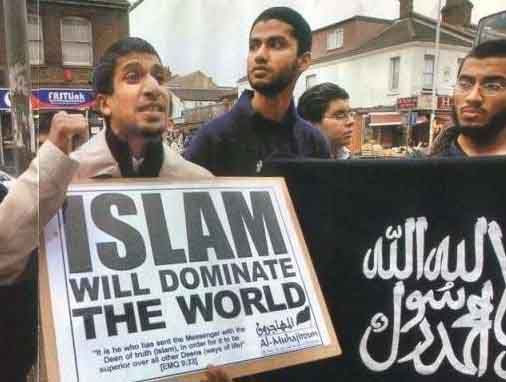
Members Of Al-Muhajiroun (The Group Which Has Now Reformed As Al-Ghurabaa)
The trouble flared just hours after Galloway's Respect party prepared to hand over a dossier of evidence of what they claim is suspicious manipulation of the postal vote system.They say they have unearthed unusual patterns of address changes in the Tower Hamlets electoral register with one voter complaining his 'liberty has been lost'.Under electoral law, it is legal to ask for a postal ballot form to be redirected to an address other than your own as long as it is completed in private by the voter.However, Respect party officials have shown the Advertiser numerous examples of where dozens of postal ballot forms are being redirected to the same address.Respect point out that most of the activity has been happening within the Bengali community.Masud Ahmed, 31, contacted Respect after he received a letter from the council at his address in Mile End telling him postal votes for him and his wife were being sent to a house Ben Jonson Road, which is in a different ward of St Dunstan's and Stepney Green."I was told it was being sent to a flat in Solent House which I've never heard of," he said."The council are investigating, but I feel I've lost my liberty."His sister and parents have also been unexpectedly told their ballot forms are being sent elsewhere.Postal vote applications account for 12 per cent of the total electoral register with almost 5,000 arriving, many by hand, at the Town Hall in the last eight days before the registration deadline.Wards that saw a surge in last minute applications included Limehouse, Shadwell and Bethnal Green South.A Respect party official who handed his dossier to Special Branch yesterday (Wednesday), said: "Someone's trying to steal the election." The council this week admitted that its systems had flagged up 'irregularities' over the Easter weekend.A spokeswoman said: "We immediately launched a confidential postal vote probe with the police."The council indicated in a statement to the Advertiser that the electoral law needed tightening.Meanwhile, trouble at the Brady Centre hustings, which was attended by Galloway, Tower Hamlets council leader Michael Keith and other senior politicians, broke out about 30 minutes into the meeting.As the council's deputy leader Abdus Shukur rose to speak, a group that had until then sat huddled, whispering to each other at the back of the main theatre room, leapt up and shouted: "Are you Muslim? Who are you to stand there? "Allah is the one who legislates, not Man."Several in the 100-plus audience squared up to them, shouting in a head-to-head face-off. Members of the Bengali community angrily jabbed fingers their way, yelling: "Get out of this country if you want Shariah law - just leave us." Police arrived some 15 minutes later, but the group tried to flee. As officers tried to calm them down, their anger turned towards the press. An Advertiser photographer who was taking pictures of the melee was warned by sect members: "We'll beat you up. We hate you people." Back inside, Omar Faruk, the chairman of the chaotic meeting, said: "Sometimes I'm ashamed to be a Muslim. Please let us have a calm debate." But his plea went unheard and politicians traded insults at each other. At one point Cllr Shukur actually screamed at people. In one other angry exchange, Respect's Cllr Oliur Rahman strode down from the audience and challenged Cllr Keith to "step outside". "It was for a debate," Cllr Rahman clarified later.

Tuesday, April 25, 2006
Arrests in terror operation
A total of four men have been arrested under anti-terrorism law following an operation in Clackmannanshire.
Atif Siddique, 20, was detained in Alva on 13 April.
Mr Siddique's older brother, Asif Siddique, 24, and his uncle Mohammed Rafiq, 40, were detained at an address in Alva at about 0900 BST on Monday.
A third man, 46-year-old Mohammed Niaz, 46 from Bridge of Allan, near Stirling, was detained later in the afternoon, Central Scotland Police confirmed.
The arrest followed the search of a property in the town.
The men arrested are being held at Govan police station in Glasgow.
The family solicitor Aamer Anwar condemned the earlier two arrests on Monday and said the men should be released.
He said: "I strongly condemn police tactics which are a sign of increased desperation to widen the net.
"This is a respectable family, who since the arrest of their son, have fully co-operated with the police in their inquiries, yet find themselves being terrorised in this manner.
"The Siddique family are deeply distressed and anxious that both Asif and Mohammed Rafiq who have committed no crime are released immediately."
BBC Scotland reporter Duncan Kirkhope, who witnessed part of the Bridge of Allan operation, described seeing "a sea of police and vehicles".
He said he was driving through the main street in Bridge of Allan with his son just before 0930 BST on Monday when he saw police motorbikes blocking off the narrow one-way Union Street in the town centre.
"I looked down the street and all I could see was a sea of police and vehicles - mainly uniformed officers and marked police cars," he said.
"By the time we got parked and walked round a number of the marked vehicles drove away and then we saw people being driven away from the semi-detached house in unmarked police cars.
"One unmarked car had three Asian people in the back, possibly two women and a young person or a woman and two young people."
Forensic teams
The other car - a Peugeot - had one Asian male, possibly in his 50s, in the back seat.
No-one appeared to be handcuffed.
"Then the forensic teams moved in from several vans. They took boxes into the two-storey house along with camera equipment," our reporter added.
"I saw eight or nine people in white suits going in the front door of the house or round the back. Another van stood outside with five or six more in it."
Police were granted more time to question Atif Siddique, with his detention period due to expire on Thursday morning.
this is not down town bagdad you know...
Two brothers were stabbed to death after a gang of men attacked their van in south-west London.
Mohammad and Hayder Ali, aged 23 and 24, were found fatally wounded outside a house in Fircroft Road, Tooting, on Saturday. Both later died in hospital.
They were attacked by a gang of up to 15 men, who smashed the van's windows. The two then either climbed out or were dragged out, before being stabbed.
Three of the seven men arrested over the deaths have been released on bail.
Knives and baseball bats
A third man, who was in the driver's seat throughout the attack, was unharmed.
Mohammad, from Battersea, south London and Hayder, of Southfields, south-west London, were attacked at the junction of Fircroft Road and Tooting High Street at about 0016 BST on Saturday.
We are keeping an open mind as to why one group of Asian men attacked another Det Ch Insp Mick Duthie
Police said a large number of weapons, including knives and baseball bats, were being examined by forensic experts.
Det Ch Insp Mick Duthie said: "At this early stage of the investigation we are keeping an open mind as to why one group of Asian men attacked another.
"This attack on two young men has resulted in a family losing not one, but two sons."
He appealed to the local community and anyone who has information to help catch those responsible.
Roads surrounding Upper Tooting Road were sealed off as officers carried out forensic examinations.
Another man has been charged
Two British nationals were among those injured in the attacks in egypt.
Foreign Secretary Jack Straw has condemned the "callous terrorists" who bombed the Egyptian resort of Dahab.
The British Embassy in Cairo has confirmed two British nationals were among those injured in the attacks, which killed at least 23 people.
The British ambassador has travelled to Dahab. He visited the two injured Britons in hospital in Sharm el-Sheikh.
Both have now been moved to a Cairo hospital for further treatment.
Three explosions occurred in a bustling area popular with tourists during the early evening when many people would have been out in cafes and restaurants.
The foreign secretary said he had sent a message of condolence and solidarity to Egyptian Foreign Minister Ahmed Aboul-Gheit, and was in close contact with the Egyptian authorities.
"I utterly condemn these appalling bombings in Dahab, which have been targeted at a popular holiday resort and on an Egyptian public holiday," said Mr Straw on Monday.
"Once again terrorists have demonstrated their callous disregard for human life.
"The people of Egypt have shown great resolve in the face of previous terrorist attacks, and we stand side by side with them once again."
The three blasts occurred at around 1900 (1800 BST) in a busy shopping and restaurant area close to the seafront, eyewitnesses said.
Dahab is a low-key resort popular with Western backpackers, divers and budget Israeli tourists.
Blair condemns Egyptian bombings
For every extra million tourists that come to Egypt there are another 200,000 jobs created British ambassador, Sir Derek Plumley
The British ambassador, Sir Derek Plumley, told BBC News he and a team from the British consulate in Cairo had opened temporary offices in Dahab and Sharm el-Sheikh "just to check with regard to other British citizens who are here at the present moment who might have concerns".
The two injured British nationals were not thought to be in a "critical condition", he added.
Dahab was a "very, very beautiful place" and it was "particularly sad" the bombings had happened there, Sir Derek told BBC News.
Tourism was "vitally important" to Egypt, he added.
"It is one of its major sources of income... a major employer.
"For every extra million tourists that come to Egypt there are another 200,000 jobs created.
"And this is a top priority for the government."
Middle East analyst Simon Henderson told BBC News the Egyptian government would be "tremendously embarrassed".
"They try to make out Egypt is a friendly and attractive place for foreigners," he added.
The main suspects would be a local group "inspired" by al-Qaeda, Mr Henderson.
Southern Sinai peninsula resorts have been hit several times by bomb attacks.
See the aftermath of the attacks
There had been talk that a number of people involved with those previous attacks were still at large BBC security correspondent Gordon Corera
Sixty-four people, including 11 Britons, were killed last July in a similar attack in Sharm el-Sheikh, further south along the coast.
BBC security correspondent Gordon Corera said the latest bombs - "bags of explosives left in various shops and cafes" - had been "slightly more primitive" than those used in the previous attacks.
"Those previous attacks were blamed on local militants supported by Bedouin tribes from the Sinai aggrieved at both the Egyptian state and foreign tourists coming in.
"And there had been talk that a number of people involved with those previous attacks were still at large."
The "initial working assumption" was a local group "inspired by but not directed by al-Qaeda" was responsible, Corera added.
As we realised what was going on and tried to make our way out of the restaurant, the third bomb blast went off Steve Riches, British tourist
Steve Riches, from Essex, said he had been about 100 metres from the first two explosions.
He told BBC Radio Five Live he and his friends, who are trained diving instructors, tried to help with first aid.
"As we realised what was going on and tried to make our way out of the restaurant, the third bomb blast went off and that was about 60 or 70 metres away, so pretty loud, pretty scary," he said.
"We got involved as much as we could while trying to keep to a relatively safe distance.
"It was pretty chaotic and pretty confusing."
Another British tourist, Paul McBeath, said the blasts came with "no warning whatsoever".
He told Sky News: "There were just three loud bangs and people rushing around. Everybody is shaken."
Family's escape from Egypt bombs
Subscribe to:
Posts (Atom)